01Overview
Ani-F0rum is a cloud-native application built with three teammates: an anime forum with social networking woven in. Users follow series from the MyAnimeList dataset, open topics, earn achievements, get recommendations — all inside one platform.
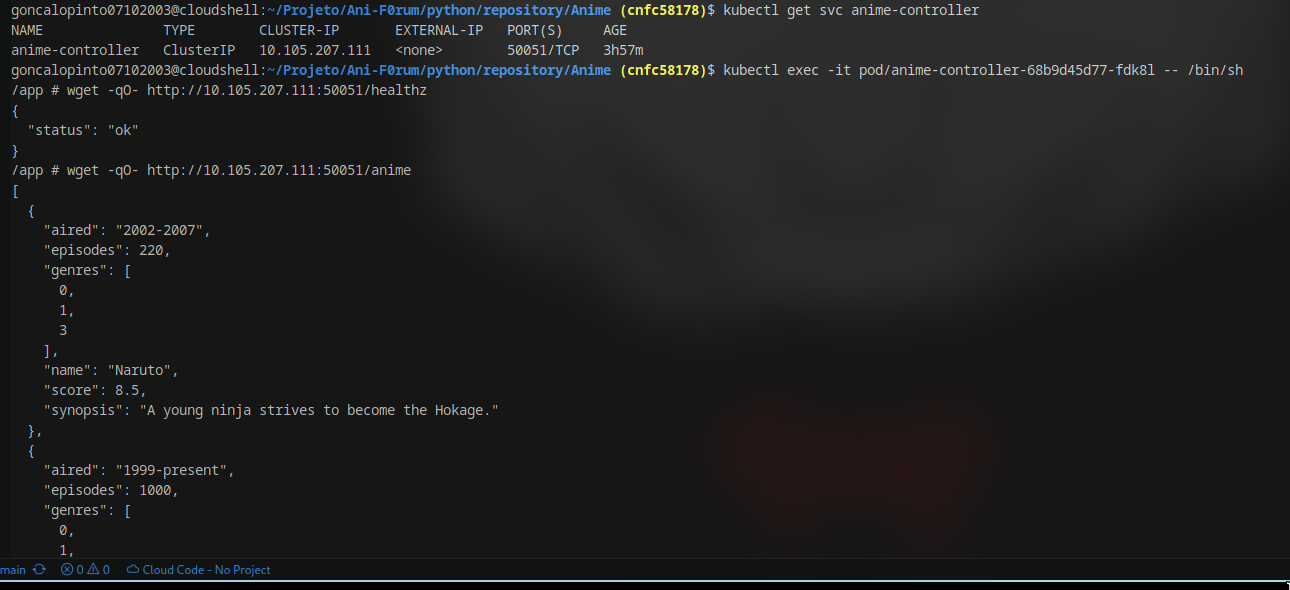
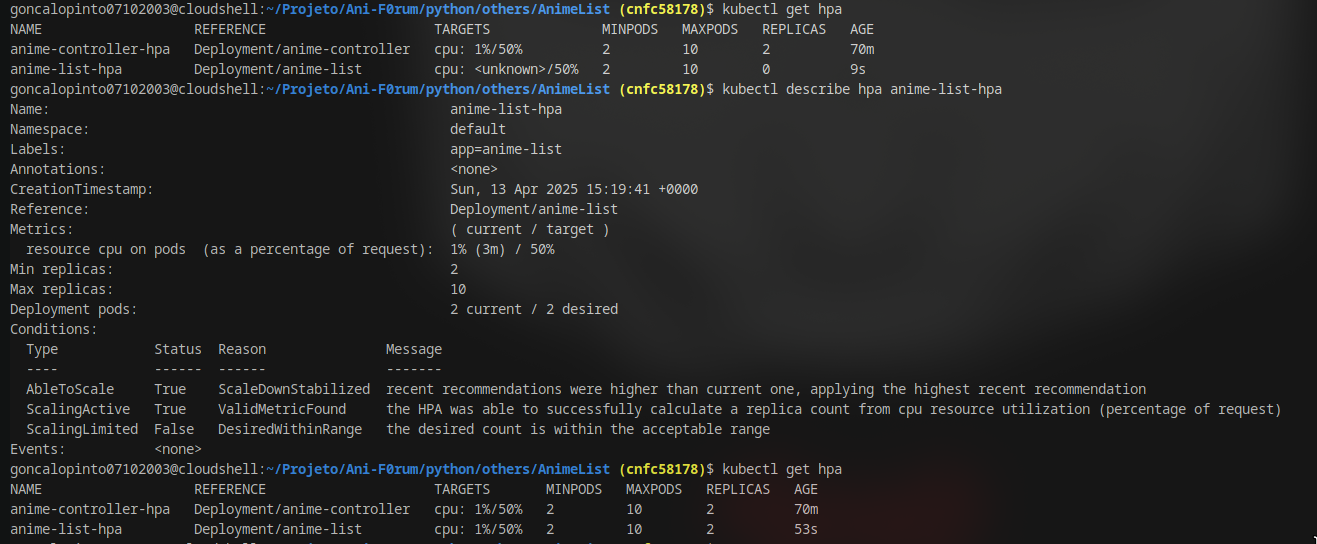
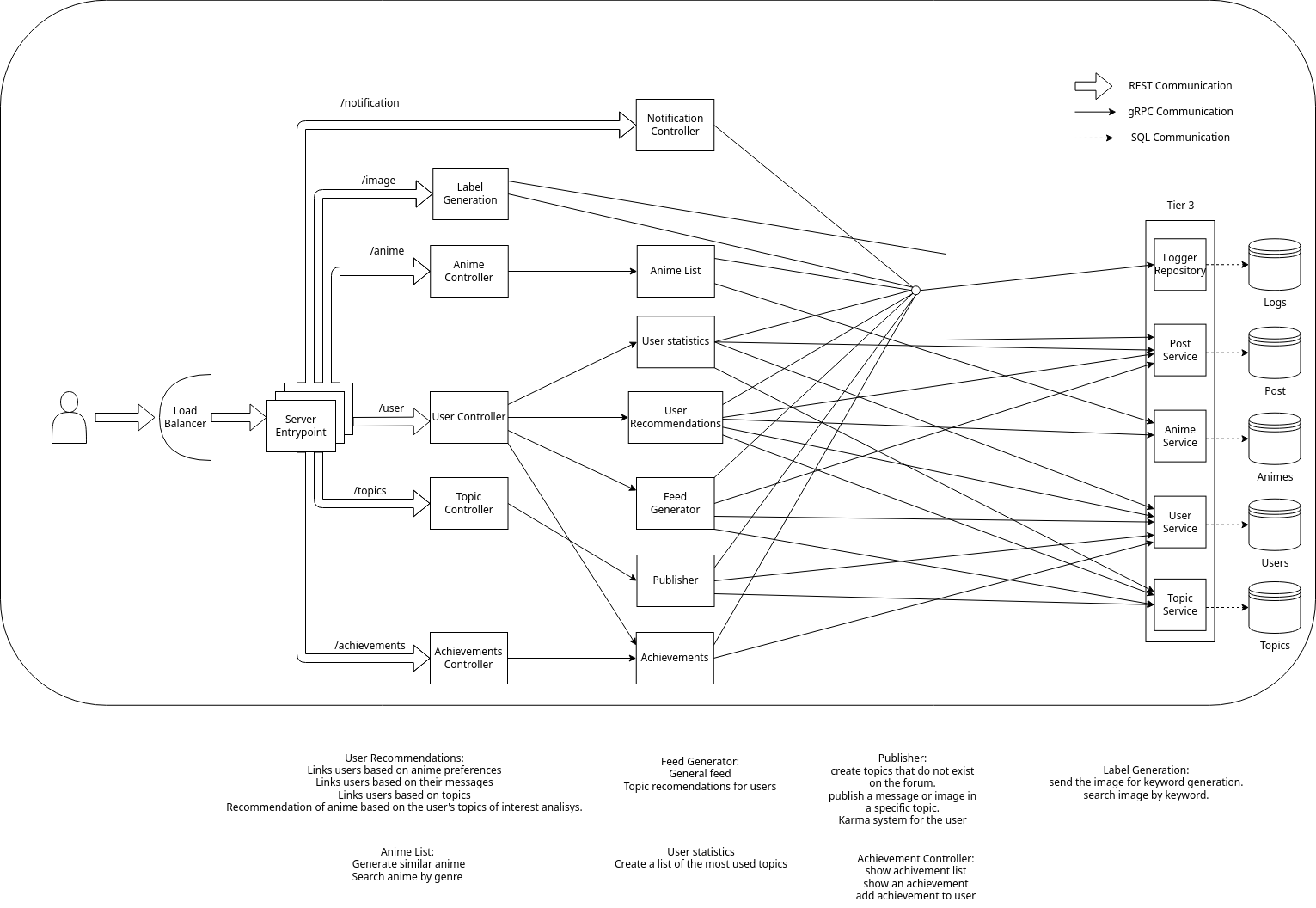
Everything is a Python microservice behind gRPC contracts defined per domain in .proto files (anime, topics, users, achievements, anime lists, feed generation…), with REST exposed at the edges. Each service ships with its own Kubernetes deployment plus an autoscaler, health probes and resource limits — the anime list demonstrably scales itself under load.
02Architecture
03How it fits together
- Controllers implement the REST endpoints (e.g. the anime controller serving details and similar titles) and call inward over gRPC.
- Repositories own database access per domain — anime data, genres, related titles.
- Supporting services do the social work: achievements, anime lists, a feed generator, a publisher, user recommendations and statistics.
- Kubernetes runs it all on Google Cloud: per-service deployments, HPA scalers, liveness/readiness/startup probes. An HTTP ingress was the one piece left unfinished.
- Tests cover controllers and repositories per domain, and a Swagger file documents the REST surface.
04Stack
| Language | Python services, each containerized with its own Dockerfile |
|---|---|
| Edge | connexion on Flask + Uvicorn (ASGI), Swagger-defined REST, 19 documented paths |
| Inside | gRPC with per-domain .proto contracts; services address each other by Kubernetes DNS |
| Platform | Google Cloud + Kubernetes: per-service deployments, HPA scalers, liveness/readiness/startup probes; gateway, ingress and route manifests |
| Data | MyAnimeList Kaggle dataset (titles, genres, ratings); repository tier per domain |
| Quality | pytest suites mirroring the controller/repository split; an entry-point health root |
05Under the hood
- Contracts first. Ten
.protofiles define every domain (anime, topics, users, achievements, lists, feeds…) before a line of service code — the IDL is the documentation. - Swagger-driven REST. Controllers are built on connexion with a checked-in
swagger.yml, then fan out to gRPC stubs addressed by Kubernetes DNS (anime-list:50052), keeping HTTP at the edge and binary protocols inside. - Social mechanics as services. Achievements, anime lists, a feed generator, a publisher, user recommendations and statistics are all first-class microservices — the "social network" isn't a feature flag, it's infrastructure.
- Tests mirror the architecture. A
Tests/tree follows the controller/repository split per domain, so every tier is exercised where it lives — several with their own Dockerfiles.
06Proof it runs